
Avaliação da dependência entre uso/cobertura do solo e qualidade da água
comparação entre uma pequena e uma grande bacia no Uruguai
DOI:
https://doi.org/10.31285/AGRO.27.1192Palavras-chave:
qualidade da água, uso/cobertura do solo, aprendizado não supervisionado, características relevantesResumo
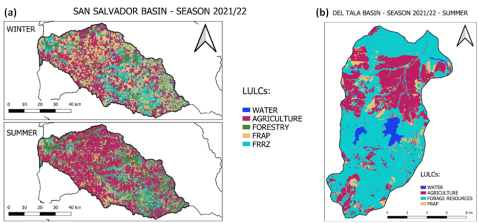
Alterações no uso do solo/cobertura do solo (LULC) afetam diretamente ou indiretamente a qualidade da água em cursos d'água e reservatórios. Estratégias de gestão sustentável voltadas para melhorar a saúde do ecossistema e o bem-estar da comunidade requerem uma avaliação precisa da qualidade da água. Este estudo examina a correlação entre mudanças temporais no LULC, representadas por variáveis de paisagem selecionadas (área e proporção de cobertura do solo, densidade de manchas, distância euclidiana até o vizinho mais próximo, índice de forma média e índice de Shannon), e variáveis de qualidade da água (nitrato, fósforo total e sólidos suspensos totais) em escala de bacia hidrográfica. Para comparar a influência do tamanho da bacia hidrográfica, essa análise foi realizada em duas escalas espaciais diferentes, representadas por duas bacias uruguaias de tamanhos diferentes, San Salvador (3118 km2) e Del Tala (160 km2). Modelos de aprendizado de máquina não supervisionados de Mínimos Quadrados Parciais e Floresta Aleatória foram empregados para essa análise. Ao explorar um método não enviesado pelo modelo baseado na teoria dos jogos (SHAP), as características de LULC foram quantificadas e classificadas com base em seu nível de importância na avaliação da qualidade da água. Os principais resultados deste estudo mostraram que a densidade de manchas é uma das métricas mais influentes em ambas as bacias hidrográficas e para ambos os modelos. O uso agrícola da terra é crítico em ambas as bacias hidrográficas, e o uso agrícola com cultivo forrageiro é o mais importante para ambos os algoritmos. Além disso, é possível afirmar que as técnicas adotadas são ferramentas valiosas que podem fornecer uma visão adequada do comportamento da qualidade da água no espaço e no tempo e das correlações entre as variáveis de qualidade da água e LULC.
Downloads
Referências
Amiri BJ, Nakane K. Modeling the linkage between river water quality and landscape metrics in the Chugoku district of Japan. Water Resour Manag. 2009;23(5):931-56. DOI: https://doi.org/10.1007/s11269-008-9307-z
Arbeletche P, Ernst O, Hoffman E. La agricultura en Uruguay y su evolución. In: García Préchac F, Ernst O, Arbeletche P, Bidegain MP, Pritsch C, Ferenczi A, Rivas M, editores. Intensificación agrícola: oportunidades y amenazas para un país productivo y natural. Montevideo: Universidad de la República; 2010. pp. 13-27.
Aubriot L, Delbene L, Haakonson S, Somma A, Hirsch F, Bonilla S. Evolución de la eutrofización en el Río Santa Lucía: influencia de la intensificación productiva y perspectivas. Innotec. 2017;14:7-17. Doi: 10.26461/14.04. DOI: https://doi.org/10.26461/14.04
Breiman L. Random forests. Machine learning. 2001;45:5-32. DOI: https://doi.org/10.1023/A:1010933404324
Bridges CC. Hierarchical Cluster Analysis. Psychol Rep. 1966;18(3):851-4. Doi: 10.2466/pr0.1966.18.3.851. DOI: https://doi.org/10.2466/pr0.1966.18.3.851
Bu H, Meng W, Zhang Y, Wan J. Relationships between land use patterns and water quality in the Taizi River basin, China. Ecol Indic. 2014;41:187-97. DOI: https://doi.org/10.1016/j.ecolind.2014.02.003
Caracterización de las cuencas del río San Salvador, río Yí Y río Arapey para fines de riego. Montevideo: MGAP; 2017. 198p.
CARU. Digesto sobre el uso y aprovechamiento del Río Uruguay [Internet]. Paysandú: CARU; 2019 [cited 2023 Oct 05]. 140p. Available from: https://bit.ly/3RRliBl
Centurion V, Fabre A, Kok P, Badano L, Neighbur N, Gelos M, Rodo E, Hoffmeister M, De Leon L. Evolución de la calidad de agua en la cuenca del río San Salvador: periodo 2014–2019. Montevideo: MVOTMV; 2020. 76p.
Ciganda V, Lizarralde C, Eguren G. Establecimiento de engorde a corral bovino o feedlots: cuantificación de su impacto sobre los recursos suelo y agua. Revista INIA. 2015;(41):39-44.
Cross T, Sathaye K, Darnell K, Niederhut D, Crifasi K. Predicting water production in the Williston basin using a machine learning model. In: Unconventional Resources Technology Conference, Virtual, 20–22 July 2020. [place unknown: publisher unknown]; 2020. pp. 3492–503. Doi: 10.15530/urtec-2020-2756. DOI: https://doi.org/10.15530/urtec-2020-2756
De la Fuente E, Suárez SA. Problemas ambientales asociados a la actividad humana: la agricultura. Ecol Austral. 2008;18:239-52.
ESA. Sentinel-2 Mission Guide [Internet]. [place unknown]: ESA; [date unknown; cited 2023 Oct 05]. Available from: https://sentinels.copernicus.eu/web/sentinel/missions/sentinel-2
Fisher B, Turner RK, Morling P. Defining and classifying ecosystem services for decision making. Ecol Econ. 2009;68:643-53. DOI: https://doi.org/10.1016/j.ecolecon.2008.09.014
Frazier A. Landscape Metrics. In: Wilson JP, editor.The geographic information science & technology: body of knowledge. 2nd ed. [place unknown]: University Consortium for Geographic Information Science; 2019. Doi: 10.22224/gistbok/2019.2.3. DOI: https://doi.org/10.22224/gistbok/2019.2.3
García AR, Fleite SN, Ciapparelli I, Vázquez Pugliese D, Weigandt C, Fabrizio de Iorio A. Observaciones, desafíos y oportunidades en el manejo de efluentes de feedlot en la provinicia de Buenos Aires, Argentina. Ecol Austral. 2015;25(3):255-62. DOI: https://doi.org/10.25260/EA.15.25.3.0.238
Ghazaryan G, Dubovyk O, Löw F, Lavreniuk M, Kolotii A, Schellberg J, Kussul N. A rule-based approach for crop identification using multi-temporal and multi-sensor phenological metrics. Eur J Remote Sens. 2018;51(1):511-24. DOI: https://doi.org/10.1080/22797254.2018.1455540
Google. Google Earth Engine [Internet]. Mountain View: Google; [date unknown; cited 2023 Oct 05]. Available from: https://earthengine.google.com/
Google Colab [Internet]. Mountain View: Google; 2023 [cited 2023 Oct 05]. Available from: https://colab.research.google.com/
Gorgoglione A, Gregorio J, Ríos A, Alonso J, Chreties C, Fossati M. Influence of land use/land cover on surface-water quality of Santa Lucía River, Uruguay. Sustainability. 2020;12(11):4692. Doi: 10.3390/su12114692. DOI: https://doi.org/10.3390/su12114692
Hammer Ø, Harper DA, Ryan PD. PAST: Paleontological statistics software package for education and data analysis. Palaeontol Electron [Internet]. 2001 [cited 2023 Oct 05];4(1):9p. Available from: https://palaeo-electronica.org/2001_1/past/past.pdf
Hesselbarth MHK, Sciaini M, With KA, Wiegand K, Nowosad J. Landscape metrics: an open‐source R tool to calculate landscape metrics. Ecography. 2019;42(10):1648-57. DOI: https://doi.org/10.1111/ecog.04617
Horning N. Land cover classification methods [Internet]. Version 1.0. New York: American Museum of Natural History;2004 [cited 2023 Oct 05]. Available from: https://www.amnh.org/content/download/74344/1391366/file/land-cover-classification-methods.pdf
Huang C, Kim S, Song K, Townshed JRG, Davis P, Altstatt A, Rodas O, Yanosky A, Clay R, Tucker CJ, Musinsky J. Assessment of Paraguay’s forest cover change using landsat observations. Glob Planet Change. 2009;67:1-12. Doi: 10.1016/j.gloplacha.2008.12.009. DOI: https://doi.org/10.1016/j.gloplacha.2008.12.009
IDEUY: Infraestructura de Datos Espaciales [Internet]. Montevideo: Uruguay Presidencia; [date unknown; cited 2023 Oct 05]. Available from: https://visualizador.ide.uy/ideuy/core/load_public_project/ideuy/
Jain AK. Data clustering: 50 years beyond K-means. Pattern Recognit Lett. 2010;31(8):651-66. DOI: https://doi.org/10.1016/j.patrec.2009.09.011
Jiang Z, Huete A, Didan K, Miura T. Development of a two-band enhanced vegetation index without a blue band. Remote Sens Environ. 2008;112(10):3833-45. DOI: https://doi.org/10.1016/j.rse.2008.06.006
Kearns FR, Kelly NM, Carter JL, Resh VH. A method for the use of landscape metrics in freshwater research and management. Landsc Ecol. 2005;20:113-25. DOI: https://doi.org/10.1007/s10980-004-2261-0
Lee SW, Hwang SJ, Lee SB, Hwang HS, Sung HC. Landscape ecological approach to the relationships of land use patterns in watersheds to water quality characteristics. Landsc Urban Plan. 2009;92(2):80-9. DOI: https://doi.org/10.1016/j.landurbplan.2009.02.008
Lintern A, Webb JA, Ryu D, Liu S, Bende-Michl U, Waters D, Leahy P, Wilson P, Western AW. Key factors influencing differences in stream water quality across space. WIREs Water. 2018;5:e1260. Doi: 10.1002/wat2.1260. DOI: https://doi.org/10.1002/wat2.1260
Liu A, Duodu GO, Goonetilleke A, Ayoko GA. Influence of land use configurations on river sediment pollution. Environ Pollut. 2017;229:639-46. DOI: https://doi.org/10.1016/j.envpol.2017.06.076
Lundberg SM, Lee SI. A unified approach to interpreting model predictions. In: Guyon I, Luxburg UV, Bengio S, Wallach H, Fergus R, Vishwanathan S, Garnett R, editors. Advances in Neural Information Processing Systems 30. New York: NIPS; 2017. pp. 4765-74.
Maaten L van der, Hinton G. Visualizing data using t-SNE. J Mach Learn Res. 2008;9:2579-605.
McGarigal K, Marks BJ. FRAGSTATS: spatial pattern analysis program for quantifying landscape structure. Portland: USDA; 1995. 122p. DOI: https://doi.org/10.2737/PNW-GTR-351
Melgar R, Vitti G, De Melo V. Soja en Latinoamérica: fertilizando para altos rendimientos. IIP Boletín. 2011;20:81p.
Ministerio de Ambiente, OAN (UY). Observatorio Ambiental Nacional [Internet]. Montevideo: MA; [date unknown; cited 2023 Oct 05]. Available from: https://www.ambiente.gub.uy/oan/
Ministerio de Ganadería, Agricultura y Pesca (UY). Mapa integrado de cobertura/uso del suelo del Uruguay año 2018 [Internet]. Montevideo: MGAP; 2019 [cited 2023 Oct 05]. Available from: https://bit.ly/3rDrVN0
Ministerio de Ganadería, Agricultura y Pesca, DGRN (UY). Actualización de cobertura y uso del suelo del Uruguay al año 2020/2021 [Internet].Montevideo: MGAP; 2021[cited 2023 Oct 05]. Available from: https://bit.ly/45z8kM9
Mon R, Irurtia C, Botta G, Pozzolo O, Bellora F, Rivero D, Bomben M. Effects of supplementary irrigation on chemical and physical soil properties in the rolling pampa region of Argentina. Cienc Investig Agrar. 2007;34(3):187-94. DOI: https://doi.org/10.4067/S0718-16202007000300002
Monteiro MIC, Ferreira FN, De Oliveira NMM, Avila AK. Simplified version of the sodium salicylate method for analysis of nitrate in drinking waters. Anal Chim Acta. 2003;477(1):125-9. DOI: https://doi.org/10.1016/S0003-2670(02)01395-8
Paruelo JM, Guerschman JP, Piñeiro G, Jobbágy EG, Verón SR, Baldi G, Baeza S. Cambios en el uso de la tierra en Argentina y Uruguay: marcos conceptuales para su análisis. Agrociencia. 2006;10(2):47-61. Doi: 10.31285/AGRO.10.929. DOI: https://doi.org/10.31285/AGRO.10.929
Pedregosa F, Varoquaux G, Gramfort A, Michel V, Thirion B, Grisel O, Blondel M, Prettenhofer P, Weiss R, Dubourg V, Vanderplas J, Passos A, Cournapeau D, Brucher M, Perrot M, Duchesnay E. Scikit-learn: machine learning in Python. J Mach Learn Res. 2011;12:2825–30.
Plan de monitoreo río San Salvador:informe de actividades y presentación de resultados: 2015. Montevideo: MVOTMA; 2016. 67p.
Russo C, Castro A, Gioia A, Iacobellis V, Gorgoglione A. A Stormwater management framework for predicting first flush intensity and quantifying its influential factors. Water Resour Manag. 2023;37:1437-59. DOI: https://doi.org/10.1007/s11269-023-03438-8
Russo C, Castro A, Gioia A, Iacobellis V, Gorgoglione A. Improving the sediment and nutrient first-flush prediction and ranking its influencing factors: an integrated machine-learning framework. J Hydrol. 2023;616:128842. Doi: 10.1016/j.jhydrol.2022.128842. DOI: https://doi.org/10.1016/j.jhydrol.2022.128842
Shapley LS. A value for n-person games. In: Kuhn H, Tucker A, editors. Contributions to the Theory of Games. Vol 2. Princeton: Princeton University Press; 1953. pp. 307-17. DOI: https://doi.org/10.1515/9781400881970-018
Sharma A, Mishra PK. State-of-the-art in performance metrics and future directions for data science algorithms. J Sci Res. 2020;64(2):221-38. Doi: 10.37398/JSR.2020.640232. DOI: https://doi.org/10.37398/JSR.2020.640232
Shi ZH, Ai L, Li X, Huang XD, Wu GL, Liao W. Partial least-squares regression for linking land-cover patterns to soil erosion and sediment yield in watersheds. J Hydrol. 2013;498:165-76. DOI: https://doi.org/10.1016/j.jhydrol.2013.06.031
Standard methods: for examination of water and wastewater. 15th ed. Washington: APHA; 1995. 1134p.
Tomic O, Graff T, Liland KH, Naes T. Hoggorm: a python library for explorative multivariate statistics. J Open Source Softw. 2019;4(39):980. Doi: 10.21105/joss.00980. DOI: https://doi.org/10.21105/joss.00980
Uuemaa E, Roosaare J, Mander Ü. Landscape metrics as indicators of river water quality at catchment scale. Hydrol Res. 2007;38(2):125-38. DOI: https://doi.org/10.2166/nh.2007.002
Uuemaa E, Roosaare J, Mander Ü. Scale dependence of landscape metrics and their indicatory value for nutrient and organic matter losses from catchments. Ecol Indic. 2005;5(4):350-69. DOI: https://doi.org/10.1016/j.ecolind.2005.03.009
Van Opstal NV, Caviglia OP, Melchiori RJM. Water and solar radiation productivity of double-crops in a humid temperate area. Aust J Crop Sci. 2011;5(13):1760-6.
Vilaseca F, Castro A, Chreties C, Gorgoglione A. Daily rainfall-runoff modeling at watershed scale: a comparison between physically-based and data-driven models. In: Gervasi O, Murgante B, Misra S, Garau C, Blečić I, Taniar D, Apduhan BO, Rocha AMAC, Tarantino E, Torre CM, editors. Computational Science and Its Applications: ICCSA 2021. Cham: Springer; 2021. pp. 18-33. DOI: https://doi.org/10.1007/978-3-030-87007-2_2
Wang J, Bao W, Gao Q, Si W, Sun Y. Coupling the Xinanjiang model and wavelet-based random forests method for improved daily streamflow simulation. J Hydroinformatics. 2021;23:589-604. DOI: https://doi.org/10.2166/hydro.2021.111
Withers PJ, Neal C, Jarvie HP, Doody DG. Agriculture and eutrophication: where do we go from here? Sustainability. 2014;6:5853-75. Doi: 10.3390/su6095853. DOI: https://doi.org/10.3390/su6095853
Xu S, Li SL, Zhong J, Li C. Spatial scale effects of the variable relationships between landscape pattern and water quality: example from an agricultural karst river basin, Southwestern China. Water Resour Manag. 2020;300:106999. Doi: 10.1016/j.agee.2020.106999. DOI: https://doi.org/10.1016/j.agee.2020.106999
Zhong S, Zhang K, Wang D, Zhang H. Shedding light on ‘‘Black Box’’ machinelearning models for predicting the reactivity of HO radicals toward organic compounds. Chem Eng J. 2021;405:126627. Doi: 10.1016/j.cej.2020.126627. DOI: https://doi.org/10.1016/j.cej.2020.126627
Downloads
Publicado
Como Citar
Edição
Seção
Licença
Copyright (c) 2023 Agrociencia Uruguay

Este trabalho está licenciado sob uma licença Creative Commons Attribution 4.0 International License.
| Métricas do artigo | |
|---|---|
| Vistas abstratas | 13172 |
| Visualizações da cozinha | 533 |
| Visualizações de PDF | 533 |
| Visualizações em HTML | 0 |
| Outras visualizações | 0 |


















