Editorial process
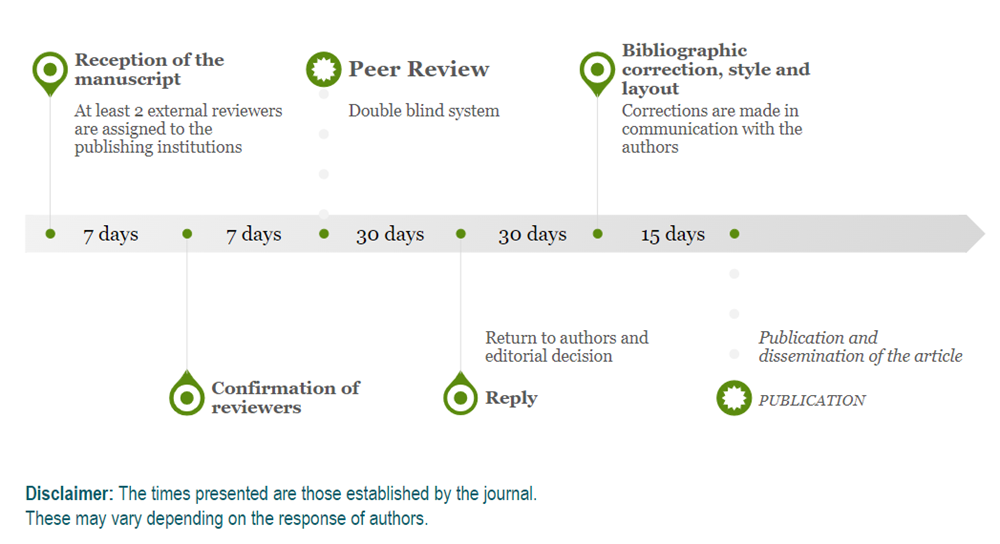
Manuscripts will be received only by the platform through the link "Send an article" and will correspond to the document type of editorial (only by invitation), scientific article, review (only by invitation) and technical note. They must be sent in the journal’s template.
For regular issues see here.
For special issues see here.
All manuscripts will be examined by a plagiarism detection software, called Compilatio, and filtered from author identification data, before starting the editorial process.
Subsequently, the editors-in-chief will assign a section editor, who will declare no conflict of interest with the authors. The editors of Agrociencia Uruguay are periodically evaluated and have a proven scientific track record.
The manuscript will then be sent to at least two peer reviewers external to the publishing institutions (Agronomy College and INIA), in a double-blind system and in accordance with the code of ethics of "COPE".
The authors are responsible for the content presented in the article and do not represent the opinion or position of the journal. At any stage of the editorial process, authors may be asked to make corrections.
Once the manuscript has been accepted by the section editors, the bibliographic and style corrections begin, as well as the layout.
Finally, the article is published and broadcasted correspondingly.