
Daño de sol y potencial hídrico de tallo y tejidos del fruto de manzanas (Malus domestica) ‘Brasil Gala’, ‘Cripps Pink’ y ‘Granny Smith’
DOI:
https://doi.org/10.31285/AGRO.27.1213Palabras clave:
daño de sol, escaldado por sol, calidad de fruta, daños abióticosResumen
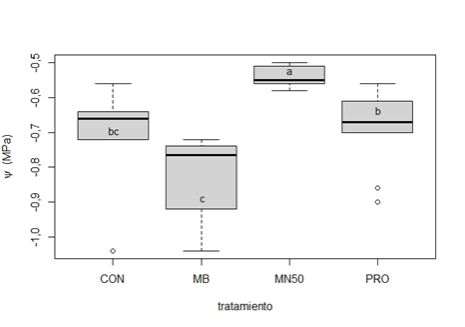
Los descartes por desórdenes fisiológicos y daños mecánicos llegan a superar el 50% de la producción de manzana en zonas con clima neotropical como Uruguay. Son daños generalmente visibles durante la maduración y el almacenamiento, pero dependen de factores que suceden en el campo. El quemado de sol se presenta en algunas temporadas como uno de los principales defectos de calidad y ha sido relacionado históricamente con altos valores de radiación y temperatura y más recientemente con el estado hídrico de los tejidos del fruto y del árbol. El presente estudio evaluó la relación del daño por sol con la condición hídrica de tejidos de fruta en Brasil Gala, Cripps Pink y Granny Smith, así como el efecto de los tratamientos para evitar el daño por sol (malla negra 50%, malla blanca translúcida 20% y aplicación de caolinita) sobre el potencial hídrico de tallo en Granny Smith. El potencial hídrico del fruto disminuyó a lo largo del ciclo de crecimiento. En los frutos ubicados en el exterior del árbol, las caras expuestas presentaron valores menores de potencial hídrico de fruto que las caras no expuestas. El efecto sobre el potencial hídrico de los tratamientos para evitar el quemado de sol solo pudo constatarse en el caso de la malla negra 50 %.
Descargas
Referencias bibliográficas
Alonso-Suárez R, Abal G, Siri R, Muse P. Satellite-derived solar irradiation map for Uruguay. Energy Procedia. 2014;57:1237-46. Doi: 10.1016/j.egypro.2014.10.072. DOI: https://doi.org/10.1016/j.egypro.2014.10.072
Bernardi RE, Holmgren M, Arim M, Scheffer M. Why are forests so scarce in subtropical South America? The shaping roles of climate, fire and livestock. For Ecol Manag. 2016;363:212-7. Doi: 10.1016/j.foreco.2015.12.032. DOI: https://doi.org/10.1016/j.foreco.2015.12.032
Boini A, Manfrini L, Morandi B, Corelli Grappadelli L, Predieri S, Daniele GM, López G. High levels of shading as a sustainable application for mitigating drought, in modern apple production. Agronomy. 2021;11:422. Doi: 10.3390/agronomy11030422. DOI: https://doi.org/10.3390/agronomy11030422
Crosa M, Burzaco P. Análisis de las perdidas y sus causas en cadenas de suministro de manzanas. In. Anuario OPYPA 2021. Montevideo: MGAP; 2021. p. 319-29.
D’Abrosca B, Pacifico S, Cefarelli G, Mastellone C, Fiorentino A. ‘Limoncella’ Apple, an Italian Apple Cultivar: phenolic and flavonoid contents and antioxidant activity. Food Chem. 2007;104:1333-7. Doi: 10.1016/j.foodchem.2007.01.073. DOI: https://doi.org/10.1016/j.foodchem.2007.01.073
Espinoza-Meza S, Ortega-Farias S, López-Olivari R, Araya-Alman M, Carrasco-Benavides M. Response of fruit yield, fruit quality, and water productivity to different irrigation levels for a microsprinkler-irrigated apple orchard (cv. Fuji) growing under Mediterranean conditions. Eur J Agron. 2023;145:126786. Doi: 10.1016/j.eja.2023.126786. DOI: https://doi.org/10.1016/j.eja.2023.126786
Ferguson I, Volz R, Woolf A. Preharvest factors affecting physiological disorders of fruit. Postharvest Biol Technol. 1999;15:255-62. Doi: 10.1016/S0925-5214(98)00089-1. DOI: https://doi.org/10.1016/S0925-5214(98)00089-1
Gindaba J, Wand SJE. Do fruit sunburn control measures affect leaf photosynthetic rate and stomatal conductance in ‘Royal Gala’ apple? Environ Exp Bot. 2007;59:160-5. Doi: 10.1016/j.envexpbot.2005.11.001. DOI: https://doi.org/10.1016/j.envexpbot.2005.11.001
Hunsche M, Blanke MM, Noga G. Does the microclimate under hail nets influence micromorphological characteristics of apple leaves and cuticles? J Plant Physiol. 2010;167(12):974-80. Doi: 10.1016/j.jplph.2010.02.007. DOI: https://doi.org/10.1016/j.jplph.2010.02.007
INIA. GRAS [Internet]. Montevideo: INIA; [cited 2023 Dec 6]. Available from: http://www.inia.uy/GRAS/
Kanayama Y, Kochetov A. Abiotic stress biology in horticultural plants. Tokyo: Springer; 2015. 220p. Doi: 10.1007/978-4-431-55251-2. DOI: https://doi.org/10.1007/978-4-431-55251-2
Lobos GA, Retamales JB, Hancock JF, Flore JA, Cobo N, del Pozo A. Spectral irradiance, gas exchange characteristics and leaf traits of Vaccinium corymbosum L. ‘Elliott’ grown under photo-selective nets. Environ Exp Bot. 2012;75:142-9. Doi: 10.1016/j.envexpbot.2011.09.006. DOI: https://doi.org/10.1016/j.envexpbot.2011.09.006
López G, Boini A, Manfrini L, Torres-Ruiz JM, Pierpaoli E, Zibordi M, Losciale P, Morandi B, Corelli-Grappadelli L. Effect of shading and water stress on light interception, physiology and yield of apple trees. Agric Water Manag. 2018;210:140-8. Doi: 10.1016/j.agwat.2018.08.015. DOI: https://doi.org/10.1016/j.agwat.2018.08.015
Makeredza B, Schmeisser M, Lötze E, Steyn WJ. Water stress increases sunburn in “Cripps” Pink’ apple. Hortic Sci. 2013;48(4):444-7. DOI: https://doi.org/10.21273/HORTSCI.48.4.444
Manja K, Aoun M. The use of nets for tree fruit crops and their impact on the production: a review. Sci Hortic. 2019;246:110-22. Doi: 10.1016/j.scienta.2018.10.050. DOI: https://doi.org/10.1016/j.scienta.2018.10.050
McCaskill MR, McClymont L, Goodwin I, Green S, Partington DL. How hail netting reduces apple fruit surface temperature: a microclimate and modelling study. Agric For Meteorol. 2016;226227:148-60. Doi: 10.1016/j.agrformet.2016.05.017. DOI: https://doi.org/10.1016/j.agrformet.2016.05.017
Mupambi G, Anthony BM, Layne DR, Musacchi S, Serra S, Schmidt T, Kalcsits LA. The influence of protective netting on tree physiology and fruit quality of apple: a review. Sci Hortic. 2018;236:60-72. Doi: 10.1016/j.scienta.2018.03.014. DOI: https://doi.org/10.1016/j.scienta.2018.03.014
Mupambi G, Musacchi S, Serra S, Kalcsits LA, Layne DR, Schmidt T. Protective netting improves leaf-level photosynthetic light use efficiency in ‘honeycrisp’ apple under heat stress. HortScience. 2018;53:1416-22. Doi: 10.21273/HORTSCI13096-18. DOI: https://doi.org/10.21273/HORTSCI13096-18
Mupambi G, Valverdi NA, Camargo-Alvarez H, Reid M, Kalcsits L, Schmidt T, Castillo F, Toye J. Reflective groundcover improves fruit skin color in ‘Honeycrisp’ apples grown under protective netting. HortTechnology. 2021;31(5):607-14. Doi: 10.21273/HORTTECH04776-20. DOI: https://doi.org/10.21273/HORTTECH04776-20
Naor A. Irrigation Scheduling and evaluation of tree water status in deciduous orchards. Hortic Rev. 2006;32:111-65. Doi: 10.1002/9780470767986.ch3. DOI: https://doi.org/10.1002/9780470767986.ch3
Naor A. Midday stem water potential as a plant water stress indicator for irrigation scheduling in fruit trees. Acta Hortic. 2000;(537):447-54. Doi: 10.17660/ActaHortic.2000.537.52. DOI: https://doi.org/10.17660/ActaHortic.2000.537.52
Pitchers B, Do FC, Pradal C, Dufour L, Lauri PÉ. Apple tree adaptation to shade in agroforestry: an architectural approach. Am J Bot. 2021;108:732-43. Doi: 10.1002/ajb2.1652. DOI: https://doi.org/10.1002/ajb2.1652
Racsko J, Schrader LE. Sunburn of apple fruit: historical background, recent advances and future perspectives. CRC Crit Rev Plant Sci. 2012;31:455-504. Doi: 10.1080/07352689.2012.696453. DOI: https://doi.org/10.1080/07352689.2012.696453
Reig G, Donahue DJ, Jentsch P. The efficacy of four sunburn mitigation strategies and their effects on yield, fruit quality, and economic performance of Honeycrisp Cv. Apples under Eastern New York (USA) climatic conditions. Int J Fruit Sci. 2020;20:541-61. Doi: 10.1080/15538362.2019.1605558. DOI: https://doi.org/10.1080/15538362.2019.1605558
Severino V, Arias-Sibillotte M, Dogliotti S, Frins E, Yuri JA, González-Talice J. Climatic and physiological parameters related to the progress and prediction of apple sunburn damage in a neotropical climate. Adv Hortic Sci. 2020;34:431-40. Doi: 10.13128/ahsc-9764.
Severino V, Arias-Sibillotte M, Dogliotti S, Frins E, Yuri JA, González-Talice J. Pre- and postharvest management of sunburn in ‘Granny Smith’ Apples (Malus × domestica Borkh) under neotropical climate conditions. Agronomy. 2021;11(8):1618. Doi: 10.3390/agronomy11081618. DOI: https://doi.org/10.3390/agronomy11081618
Shivashankara KS, Rao NKS, Geetha GA. Impact of climate change on fruit and vegetable quality. In: Singh H, Rao N, Shivashankar K, editors. Climate-resilient horticulture: adaptation and mitigation strategies. New Delhi: Springer; 2013. pp. 237-44. Doi: 10.1007/978-81-322-0974-4_21. DOI: https://doi.org/10.1007/978-81-322-0974-4_21
Szabó A, Tamás J, Nagy A. The influence of hail net on the water balance and leaf pigment content of apple orchards. Sci Hortic. 2021;283:110112. Doi: 10.1016/j.scienta.2021.110112. DOI: https://doi.org/10.1016/j.scienta.2021.110112
Tanny J, Cohen S, Grava A, Naor A, Lukyanov V. The effect of shading screens on microclimate of apple orchards. Acta Hortic. 2009;(807):103-8. Doi: 10.17660/ActaHortic.2009.807.11. DOI: https://doi.org/10.17660/ActaHortic.2009.807.11
Tiscornia G, Cal A, Giménez A. Análisis y caracterización de la variabilidad climática en algunas regiones de Uruguay. RIA Rev investig agropecu. 2016;42(1):66-71.
Torres CA, Sepúlveda A, González-Talice J, Yuri JA, Razmilic I. Fruit water relations and osmoregulation on apples (Malus domestica Borkh.) with different sun exposures and sun-injury levels on the tree. Sci Hortic. 2013;161:143-52. Doi: 10.1016/j.scienta.2013.06.035. DOI: https://doi.org/10.1016/j.scienta.2013.06.035
Torres CA, Sepúlveda A, Leon L, Yuri JA. Early detection of sun injury on apples (Malus domestica Borkh.) through the use of crop water stress index and chlorophyll fluorescence. Sci Hortic. 2016;211:336-42. Doi: 10.1016/j.scienta.2016.09.022. DOI: https://doi.org/10.1016/j.scienta.2016.09.022
Yuri JA. Daño por sol en manzanas. Fruticultura. 2010;8:2-9.
Descargas
Publicado
Cómo citar
Número
Sección
Licencia
Derechos de autor 2024 Agrociencia Uruguay

Esta obra está bajo una licencia internacional Creative Commons Atribución 4.0.
| Estadísticas de artículo | |
|---|---|
| Vistas de resúmenes | 38881 |
| Vistas de PDF | 441 |
| Descargas de PDF | 441 |
| Vistas de HTML | 0 |
| Otras vistas | 0 |


















