
Regulación epigenética y memoria
posibles aplicaciones en la vid en Uruguay
DOI:
https://doi.org/10.31285/AGRO.28.1267Palabras clave:
epigenética, metilación del ADN, modificaciones de histonas, vid, UruguayResumen
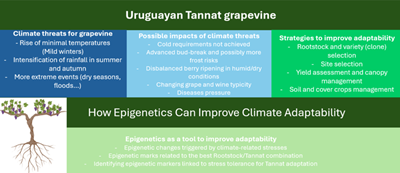
Este artículo explora los conocimientos actuales sobre la regulación epigenética en la vid, con hincapié en su importancia en plantas de propagación clonal con una diversidad genética limitada (como la vid). Los principales procesos epigenéticos, como la metilación del ADN y las modificaciones de las histonas, conforman la estructura de la cromatina e influyen en la expresión génica. El metiloma de hojas de vid revela similitudes con otras plantas de propagación clonal, destacando los bajos niveles de metilación en contextos específicos. La regulación epigenética contribuye a la plasticidad fenotípica de la vid, a la diversidad clonal y a un intrigante diálogo entre parejas injertadas. Estos mecanismos constituyen una parte vital de la memoria de las plantas, especialmente frente a los cambios climáticos. En Uruguay, donde el sector vitivinícola se enfrenta a desafíos climáticos, el tannat se sitúa como una variedad emblemática adaptada a nuestros sistemas de producción. Sin embargo, las predicciones de cambio climático en la región incluyen el aumento de las temperaturas, la alteración del régimen de precipitaciones y el incremento de eventos extremos, lo que podría impactar en algunos aspectos de su adaptación (rendimientos, calidad de bayas y tipicidad, entre otros). Las estrategias de gestión de los viñedos, junto con el fitomejoramiento, son esenciales para la adaptación. El artículo hace un llamamiento para desarrollar urgentemente estrategias innovadoras que utilicen variaciones epigenéticas heredables, presentando un enfoque más rápido y eficiente de la mejora genética de la vid para la tolerancia al estrés en el contexto del cambio climático.
Descargas
Referencias bibliográficas
Anastasiadi D, Venney CJ, Bernatchez L, Wellenreuther M. Epigenetic inheritance and reproductive mode in plants and animals. Trends Ecol Evol. 2021;36(12):1124-40. Doi: 10.1016/j.tree.2021.08.006. DOI: https://doi.org/10.1016/j.tree.2021.08.006
Bäurle I. Can't remember to forget you: chromatin-based priming of somatic stress responses. Semin Cell Dev Biol. 2018;83:133-9. Doi: 10.1016/j.semcdb.2017.09.032. DOI: https://doi.org/10.1016/j.semcdb.2017.09.032
Berger MMJ, Stammitti L, Carrillo N, Blancquaert E, Rubio B, Teyssier E, Gallusci P. Epigenetics: an innovative lever for grapevine breeding in times of climatic changes. OENO One. 2023;57(2):265-82. Doi: 10.20870/oeno-one.2023.57.2.7405. DOI: https://doi.org/10.20870/oeno-one.2023.57.2.7405
Boulias K, Greer EL. Means, mechanisms and consequences of adenine methylation in DNA. Nat Rev Genet. 2022;23(7):411-28. Doi: 10.1038/s41576-022-00456-x. DOI: https://doi.org/10.1038/s41576-022-00456-x
Crisp PA, Ganguly D, Eichten SR, Borevitz JO, Pogson BJ. Reconsidering plant memory: intersections between stress recovery, RNA turnover, and epigenetics. Sci Adv. 2016;2(2):e1501340. Doi: 10.1126/sciadv.1501340. DOI: https://doi.org/10.1126/sciadv.1501340
Delaunois B, Farace G, Jeandet P, Clément C, Baillieul F, Dorey S, Cordelier S. Elicitors as alternative strategy to pesticides in grapevine?: current knowledge on their mode of action from controlled conditions to vineyard. Environ Sci Pollut Res Int. 2014;21(7):4837-46. Doi: 10.1007/s11356-013-1841-4. DOI: https://doi.org/10.1007/s11356-013-1841-4
Ferrer M, Pereyra C, Salvarrey M, Arrillaga L, Fourment M. 'Tannat' (Vitis vinifera L.) as a model of responses to climate variability. Vitis. 2020;56:41-6. Doi: 10.5073/vitis.2020.59.41-46.
Fortes AM, Gallusci P. Plant stress responses and phenotypic plasticity in the epigenomics era: perspectives on the grapevine scenario, a model for perennial crop plants. Front Plant Sci. 2017;8:82. Doi: 10.3389/fpls.2017.00082. DOI: https://doi.org/10.3389/fpls.2017.00082
Fourment M, Ferrer M, Barbeau G, Quénol H. Local perceptions, vulnerability and adaptive responses to climate change and variability in a winegrowing region in Uruguay. Environ Manage. 2020;66(4):590-9. Doi: 10.1007/s00267-020-01330-4. DOI: https://doi.org/10.1007/s00267-020-01330-4
Fourment M, Ferrer M, Quénol H. Vitis vinifera L. cv. Tannat: respuesta a la variabilidad climática. Agrociencia (Uruguay). 2013;17(2):33-44. Doi: 10.31285/AGRO.17.433. DOI: https://doi.org/10.31285/AGRO.17.433
Fourment M, Piccardo P. What grapes and wines to expect with the drought? Agrocienc Urug. 2023;27(Supplement):e1206. Doi: 10.31285/AGRO.27.1206. DOI: https://doi.org/10.31285/AGRO.27.1206
Gallusci P, Agius DR, Moschou PN, Dobránszki J, Kaiserli E, Martinelli F. Deep inside the epigenetic memories of stressed plants. Trends Plant Sci. 2023;28(2):142-53. Doi: 10.1016/j.tplants.2022.09.004. DOI: https://doi.org/10.1016/j.tplants.2022.09.004
Gutierrez Gamboa G, Fourment M. Latin American viticulture adaptation to climate change: perspectives and challenges of viticulture facing up global warming. Cham: Springer; 2024. 250p. Doi: 10.1007/978-3-031-51325-1. DOI: https://doi.org/10.1007/978-3-031-51325-1
IPCC. Point of departure and key concepts. In: Climate Change 2022: impacts, adaptation and vulnerability: Working Group II Contribution to the Sixth Assessment Report of the Intergovernmental Panel on Climate Change. Cambridge: Cambridge University Press; 2023. p. 121-96. Doi: 10.1017/9781009325844.003. DOI: https://doi.org/10.1017/9781009325844.003
Latzel V, Rendina González AP, Rosenthal J. Epigenetic memory as a basis for intelligent behavior in clonal plants. Front Plant Sci. 2016;7:1354. Doi: 10.3389/fpls.2016.01354. DOI: https://doi.org/10.3389/fpls.2016.01354
Lauria M, Rossi V. Epigenetic control of gene regulation in plants. Biochim Biophys Acta. 2011;1809(8):369-78. Doi: 10.1016/j.bbagrm.2011.03.002. DOI: https://doi.org/10.1016/j.bbagrm.2011.03.002
Liu J, He Z. Small DNA methylation, big player in plant abiotic stress responses and memory. Front Plant Sci. 2020;11:595603. Doi: 10.3389/fpls.2020.595603. DOI: https://doi.org/10.3389/fpls.2020.595603
Lu AT, Xue L, Salfati EL, Chen BH, Ferrucci L, Levy D, Joehanes R, Murabito JM, Kiel DP, Tsai PC, Yet I, Bell JT, Mangino M, Tanaka T, McRae AF, Marioni RE, Visscher PM, Wray NR, Deary IJ, Levine ME, Quach A, Assimes T, Tsao PS, Absher D, Stewart JD, Li Y, Reiner AP, Hou L, Baccarelli AA, Whitsel EA, Aviv A, Cardona A, Day FR, Wareham NJ, Perry JRB, Ong KK, Raj K, Lunetta KL, Horvath S. GWAS of epigenetic aging rates in blood reveals a critical role for TERT. Nat Commun. 2018;9(1):387. Doi: 10.1038/s41467-017-02697-5. DOI: https://doi.org/10.1038/s41467-017-02697-5
Marfil C, Ibañez V, Alonso R, Varela A, Bottini R, Masuelli R, Fontana A, Berli F. Changes in grapevine DNA methylation and polyphenols content induced by solar ultraviolet-B radiation, water deficit and abscisic acid spray treatments. Plant Physiol Biochem. 2019;135:287-94. Doi: 10.1016/j.plaphy.2018.12.021. DOI: https://doi.org/10.1016/j.plaphy.2018.12.021
Mira de Orduña R. Climate change associated effects on grape and wine quality and production. Food research international. 2010;43(7):1844-55. DOI: https://doi.org/10.1016/j.foodres.2010.05.001
Mozgova I, Mikulski P, Pecinka A, Farrona S. Epigenetic mechanisms of abiotic stress response and memory in plants. In: Alvarez-Venegas R, De-la-Peña C, Casas-Mollano JA (Eds.). Epigenetics in plants of agronomic importance: fundamentals and applications: transcriptional regulation and chromatin remodelling in plants. Cham: Springer; 2019. p. 1-64. DOI: https://doi.org/10.1007/978-3-030-14760-0_1
Niederhuth CE, Bewick AJ, Ji L, Alabady MS, Kim KD, Li Q, Rohr NA, Rambani A, Burke JM, Udall JA, Egesi C, Schmutz J, Grimwood J, Jackson SA, Springer NM, Schmitz RJ. Widespread natural variation of DNA methylation within angiosperms. Genome Biol. 2016;17(1):194. Doi: 10.1186/s13059-016-1059-0. DOI: https://doi.org/10.1186/s13059-016-1059-0
Pikaard CS, Mittelsten Scheid O. Epigenetic regulation in plants. Cold Spring Harb Perspect Biol. 2014;6(12):a019315. Doi: 10.1101/cshperspect.a019315. DOI: https://doi.org/10.1101/cshperspect.a019315
Rubio B, Stammitti L, Cookson SJ, Teyssier E, Gallusci P. Small RNA populations reflect the complex dialogue established between heterograft partners in grapevine. Hortic Res. 2022;9:uhab067. Doi: 10.1093/hr/uhab067. DOI: https://doi.org/10.1093/hr/uhab067
Shangguan L, Fang X, Jia H, Chen M, Zhang K, Fang J. Characterization of DNA methylation variations during fruit development and ripening of Vitis vinifera (cv. 'Fujiminori'). Physiol Mol Biol Plants. 2020;26(4):617-37. Doi: 10.1007/s12298-020-00759-5. DOI: https://doi.org/10.1007/s12298-020-00759-5
Sun X, Fan G, Su L, Wang W, Liang Z, Li S, Xin H. Identification of cold-inducible microRNAs in grapevine. Front Plant Sci. 2015;6:595. Doi: 10.3389/fpls.2015.00595. DOI: https://doi.org/10.3389/fpls.2015.00595
Tan JW, Rodríguez López CM. Epigenomics: a new tool for the generation of climate resilient grapevines. Front Hortic. 2023;2. Doi: 10.3389/fhort.2023.1116866. DOI: https://doi.org/10.3389/fhort.2023.1116866
Tang D, Gallusci P, Lang Z. Fruit development and epigenetic modifications. New Phytol. 2020;228(3):839-44. Doi: 10.1111/nph.16724. DOI: https://doi.org/10.1111/nph.16724
Varela A, Ibañez VN, Alonso R, Zavallo D, Asurmendi S, Gomez Talquenca S, Marfil CF, Berli FJ. Vineyard environments influence Malbec grapevine phenotypic traits and DNA methylation patterns in a clone-dependent way. Plant Cell Rep. 2021;40(1):111-25. Doi: 10.1007/s00299-020-02617-w DOI: https://doi.org/10.1007/s00299-020-02617-w
Venios X, Gkizi D, Nisiotou A, Korkas E, Tjamos SE, Zamioudis C, Banilas G. Emerging roles of epigenetics in grapevine and winegrowing. Plants (Basel). 2024;13(4):515. Doi: 10.3390/plants13040515. DOI: https://doi.org/10.3390/plants13040515
Wibowo A, Becker C, Durr J, Price J, Spaepen S, Hilton S, Putra H, Papareddy R, Saintain Q, Harvey S, Bending GD, Schulze-Lefert P, Weigel D, Gutierrez-Marcos J. Partial maintenance of organ-specific epigenetic marks during plant asexual reproduction leads to heritable phenotypic variation. Proc Natl Acad Sci USA. 2018;115(39):E9145-E9152. Doi: 10.1073/pnas.1805371115. DOI: https://doi.org/10.1073/pnas.1805371115
Xie H, Konate M, Sai N, Tesfamicael KG, Cavagnaro T, Gilliham M, Breen J, Metcalfe A, Stephen JR, De Bei R, Collins C, Lopez CMR. Global DNA Methylation Patterns Can Play a Role in Defining Terroir in Grapevine (Vitis vinifera cv. Shiraz). Front Plant Sci. 2017;8:1860. Doi: 10.3389/fpls.2017.01860. DOI: https://doi.org/10.3389/fpls.2017.01860
Zemach A, Kim MY, Hsieh PH, Coleman-Derr D, Eshed-Williams L, Thao K, Harmer SL, Zilberman D. The Arabidopsis nucleosome remodeler DDM1 allows DNA methyltransferases to access H1-containing heterochromatin. Cell. 2013;153(1):193-205. Doi: 10.1016/j.cell.2013.02.033. DOI: https://doi.org/10.1016/j.cell.2013.02.033
Zhang YY, Latzel V, Fischer M, Bossdorf O. Understanding the evolutionary potential of epigenetic variation: a comparison of heritable phenotypic variation in epiRILs, RILs, and natural ecotypes of Arabidopsis thaliana. Heredity (Edinb). 2018;121(3):257-65. Doi: 10.1038/s41437-018-0095-9. DOI: https://doi.org/10.1038/s41437-018-0095-9
Zhu Z, Li Q, Gichuki DK, Hou Y, Liu Y, Zhou H, Xu C, Fang L, Gong L, Zheng B, Duan W, Fan P, Wang Q, Xin H. Genome-wide profiling of histone H3 lysine 27 trimethylation and its modification in response to chilling stress in grapevine leaves. Hortic Plant J. 2023;9(3):496-508. Doi: 10.1016/j.hpj.2023.03.002. DOI: https://doi.org/10.1016/j.hpj.2023.03.002
Descargas
Publicado
Cómo citar
Número
Sección
Licencia
Derechos de autor 2024 Agrociencia Uruguay

Esta obra está bajo una licencia internacional Creative Commons Atribución 4.0.
| Estadísticas de artículo | |
|---|---|
| Vistas de resúmenes | 2229 |
| Vistas de PDF | 343 |
| Descargas de PDF | 343 |
| Vistas de HTML | 0 |
| Otras vistas | 0 |


















