
Participatory Agent-Based Modeling of Grazing Management
Comparing Rotational vs Continuous Grazing Systems
DOI:
https://doi.org/10.31285/AGRO.30.1615Keywords:
multiagent modelling, economic evaluation, livestock management, optimal stocking rate, Voisin rotational grazingAbstract
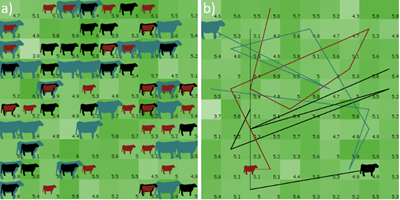
In the current context of cattle-farming intensification, improving understanding of ecosystem functioning is essential to increase productivity without raising external inputs, while also enhancing adaptability to climate change. This study presents a first implementation of a dynamic predator-prey approach using an agent-based modelling (ABM) platform (NetLogo), which enables separate yet interacting representations of cattle and pasture paddocks governed by management decisions. The objective was to develop, through a participatory process, an ABM that captures the key components and dynamics of grazing systems, and to evaluate its response to spring drought conditions by comparing rotational (ROT) and continuous (CON) grazing strategies. Both systems were simulated within the same platform, differing only in spatial cattle management. Four climate scenarios representing spring droughts were tested under varying initial grass heights and stocking rates to assess productive and economic outcomes. Across all scenarios, ROT improved per-hectare productivity by an average of 18% with lower forage allowance, compared with CON. Animal performance was strongly influenced by initial grass height and drought severity, with ROT consistently supporting higher stocking rates and achieving up to 10% greater economic performance. However, under very low stocking rates or severe drought, CON outperformed ROT economically. This shift was associated with cost structure: ROT systems carried higher fixed costs related to infrastructure, which could be diluted under conditions of higher productivity. The model illustrates how grazing management, climate variability, and system structure interact to shape physical and economic performance, highlighting the potential benefits and context-dependence of rotational grazing.
Downloads
References
Allen, V. G., Batello, C., Berretta, E. J., Hodgson, J., Kothmann, M., Li, X., McIvor, J., Milne, J., Morris, C., Peeters, A., & Sanderson, M. (2011). An international terminology for grazing lands and grazing animals. Grass and Forage Science, 66(1), 2-28. https://doi.org/10.1111/j.1365-2494.2010.00780.x DOI: https://doi.org/10.1111/j.1365-2494.2010.00780.x
Beck, P. A., Beck, M. R., Gunter, S. A., Biermacher, J. T., & Gillen, R. L. (2020). Stocking rate impacts performance and economics of grazing beef steers on mixed-grass prairies of the Southern Great Plains. Translational Animal Science, 4(3), Article txaa134. https://doi.org/10.1093/tas/txaa134 DOI: https://doi.org/10.1093/tas/txaa134
Briske, D. D., Archer, S. R., Burchfield, E., Burnidge, W., Derner, J. D., Gosnell, H., Hatfield, J., Kazanski, C. E., Khalil, M., Lark, T. J., Nagler, P. L., Sala, O. E., Sayre, N. F., & Stackhouse-Lawson, K. R. (2023). Supplying ecosystem services on US rangelands. Nature Sustainability, 6(12), 1524-1532. https://doi.org/10.1038/s41893-023-01194-6 DOI: https://doi.org/10.1038/s41893-023-01194-6
Briske, D. D., Derner, J. D., Brown, J. R., Fuhlendorf, S. D., Teague, W. R., Havstad, K. M., Gillen, R. L., Ash, A. J., & Willms, W. D. (2008). Rotational grazing on rangelands: Reconciliation of perception and experimental evidence. Rangeland Ecology & Management, 61(1), 3-17. https://doi.org/10.2111/06-159R.1 DOI: https://doi.org/10.2111/06-159R.1
Briske, D. D., Sayre, N. F., Huntsinger, L., Fernandez-Gimenez, M., Budd, B., & Derner, J. D. (2011). Origin, persistence, and resolution of the rotational grazing debate: Integrating human dimensions into rangeland research. Rangeland Ecology & Management, 64(4), 325-334. https://doi.org/10.2111/REM-D-10-00084.1 DOI: https://doi.org/10.2111/REM-D-10-00084.1
Carmo, M. do, Cardozo, G., Jaurena, M., & Soca, P. (2019). Demonstrating control of forage allowance for beef cattle grazing Campos grassland in Uruguay to improve system productivity. Tropical Grasslands-Forrajes Tropicales, 7(1), 35-47. https://doi.org/10.17138/tgft(7)35-47 DOI: https://doi.org/10.17138/tgft(7)35-47
Carvalho, P. C. F., Nabinger, C., Lemaire, G., & Genro, T. C. M. (2011). Challenges and opportunities for livestock production in natural pastures: The case of Brazilian Pampa Biome. In S. R. Feldman, G. E. Oliva, & M. B. Sacido (Eds.), Diverse rangelands for a sustainable society: Proceedings of the IX International Rangeland Congress (pp. 9-15). Asociación Argentina para el Manejo de Pastizales Naturales; INTA.
Cruz, G., Gravina, V., Baethgen, W. E., & Taddei, R. (2021). A typology of climate information users for adaptation to agricultural droughts in Uruguay. Climate Services, 22, Article 100214. https://doi.org/10.1016/j.cliser.2021.100214 DOI: https://doi.org/10.1016/j.cliser.2021.100214
Daza, A., & Martín, R. (2007). Estimación de la carga ganadera económicamente óptima en fincas de ganado vacuno de carne del ecosistema de la Dehesa. ITEA, 28(Extra 1), 294-296. https://www.aida-itea.org/aida-itea/files/jornadas/2007/comunicaciones/2007_SGEG_03.pdf
de Boer, R. J. (2018). Modeling population dynamics: A graphical approach. Utrecht University. https://tbb.bio.uu.nl/rdb/books/mpd.pdf
Dieguez, F., & Fort, H. (2019). An application of a dynamical model with ecological predator-prey approach to extensive livestock farming in Uruguay: Economical assessment on forage deficiency. Journal of Dynamics and Games, 6(2), 119-129. https://doi.org/10.3934/jdg.2019009 DOI: https://doi.org/10.3934/jdg.2019009
Dieguez, F. J., & Pereira, M. (2020). Uruguayan native grasslands net aerial primary production model and its application on safe stocking rate concept. Ecological Modelling, 430, Article 109060. https://doi.org/10.1016/j.ecolmodel.2020.109060 DOI: https://doi.org/10.1016/j.ecolmodel.2020.109060
Duarte, L. E. (2023). Características de los predios participantes y metodologías utilizadas. In L. E. Duarte & F. Dieguez (Eds.), De pasto a carne (pp. 21-25). INIA.
Enri, S. R., Probo, M., Farruggia, A., Lanore, L., Blanchetete, A., & Dumont, B. (2017). A biodiversity-friendly rotational grazing system enhancing flower-visiting insect assemblages while maintaining animal and grassland productivity. Agriculture, Ecosystems & Environment, 241, 1-10. https://doi.org/10.1016/j.agee.2017.02.030 DOI: https://doi.org/10.1016/j.agee.2017.02.030
Étienne, M. (Ed.). (2014). Companion modelling: A participatory approach to support sustainable development. Springer. https://doi.org/10.1007/978-94-017-8557-0 DOI: https://doi.org/10.1007/978-94-017-8557-0
Etienne, M., Du Toit, D., & Pollard, S. (2011). ARDI: a co-construction method for participatory modelling in natural resources management. Ecology and Society, 16(1), Article 44. http://www.ecologyandsociety.org/vol16/iss1/art44/ DOI: https://doi.org/10.5751/ES-03748-160144
Favaro Sapriza, M. (2022). Análisis de la implementación y propagación del pastoreo racional voisin y otros sistemas de pastoreo no tradicionales en Uruguay [Bachelor's thesis, Universidad de la República]. Colibri. https://hdl.handle.net/20.500.12008/42124
Godfray, H. C., Beddington, J. R., Crute, I. R., Haddad, L., Lawrence, D., Muir, J. F., Pretty, J., Robinson, S., Thomas, S. M., & Toulmin, C. (2010). Food security: The challenge of feeding 9 billion people. Science, 327(5967), 812-818. https://doi.org/10.1126/science.1185383 DOI: https://doi.org/10.1126/science.1185383
Grimm, V., Railsback, S. F., Vincenot, C. E., Berger, U., Gallagher, C. A., DeAngelis, D. L., Edmonds, B., Ge, J., Giske, J., Groeneveld, J., Johnston, A. S. A., Milles, A., Nabe-Nielsen, J., Polhill, J. G., Radchuk, V., Rohwäder, M.-S., Stillman, R. A., Thiele, J. C., & Ayllón, D. (2020). The ODD protocol for describing agent-based and other simulation models: A second update to improve clarity, replication, and structural realism. Journal of Artificial Societies and Social Simulation, 23(2), Article 7. https://doi.org/10.18564/jasss.4259 DOI: https://doi.org/10.18564/jasss.4259
Ingrisch, J., & Bahn, M. (2018). Towards a comparable quantification of resilience. Trends in Ecology & Evolution, 33(4), 251-259. https://doi.org/10.1016/j.tree.2018.01.013 DOI: https://doi.org/10.1016/j.tree.2018.01.013
Laca, E. A. (2009). Precision livestock production: Tools and concepts. Revista Brasileira de Zootecnia, 38(spe), 123-132. https://doi.org/10.1590/S1516-35982009001300014 DOI: https://doi.org/10.1590/S1516-35982009001300014
López-Pérez, M. B., Benítez, G., Guedes, E., Monteverde, S., & Dieguez, F. (2022). Caracterización de los resultados productivos y económicos en establecimientos de ganadería vacuna y ovina con sistemas de pastoreo racional Voisin en Uruguay. Archivos Latinoamericanos de Producción Animal, 30(3), 253-262. https://doi.org/10.53588/alpa.300312 DOI: https://doi.org/10.53588/alpa.300312
Machado Filho, L. C. M., Seó, H. L. S., Daros, R. R., Enriquez-Hidalgo, D., Wendling, A. V., & Pinheiro Machado, L. C. (2021). Voisin rational grazing as a sustainable alternative for livestock production. Animals (Basel), 11(12), Article 3494. https://doi.org/10.3390/ani11123494 DOI: https://doi.org/10.3390/ani11123494
McKnight, L., & Ibeagha-Awemu, E. (2019). Modeling of livestock systems to enhance efficiency. Animal Frontiers, 9(2), 3-5. https://doi.org/10.1093/af/vfz011 DOI: https://doi.org/10.1093/af/vfz011
Modernel, P., Rossing, W. A. H., Corbeels, M., Dogliotti, S., Picasso, V., & Tittonell, P. (2016). Land use change and ecosystem service provision in Pampas and Campos grasslands of southern South America. Environmental Research Letters, 11(11), Article 113002. https://doi.org/10.1088/1748-9326/11/11/113002 DOI: https://doi.org/10.1088/1748-9326/11/11/113002
Molina Riccetto, C. (2019). 18 años-monitoreo de empresas ganaderas-18 años: Resultados del ejercicio 2018-2019 y evolución desde 2001. Instituto Plan Agropecuario. https://www.planagropecuario.org.uy/uploads/monitoreos/32_Presentacion%20Resultados%20de%20Carpetas%20Verdes.%20Ejercicio%202018-2019.pdf
Moojen, F., Bremm, C., Laca, E., Machado, D., Savian, J. V., & Carvalho, P. C. F. (2022). Herbage allowance and stocking method effect on grazing systems: Results of a long-term experiment. Grass and Forage Science, 77(1), 45-54. https://doi.org/10.1111/gfs.12556 DOI: https://doi.org/10.1111/gfs.12556
Mott, G. O. (1960). Grazing pressure and the measurement of pasture production. In C. l. Skidmore (Ed.), Proceedings of the 8th International Grassland Congress (pp. 606-611). Alden Press.
Oficina de Estadísticas Agropecuarias. (2021). Anuario estadístico agropecuario 2021. MGAP. https://descargas.mgap.gub.uy/DIEA/Anuarios/Anuario2021/LIBRO%20ANUARIO%202021%20Web.pdf
Pantalla Uruguay. (n.d.). Promedios: Vamos por buen camino. https://www.pantallauruguay.com.uy/promedios/?promediosXcat=Novillos+2+a+3+a%C3%B1os
Paparamborda, I., Dogliotti, S., Soca, P., & Rossing, W. A. H. (2023). A conceptual model of cow-calf systems functioning on native grasslands in a subtropical region. Animal, 17(10), Article 100953. https://doi.org/10.1016/j.animal.2023.100953 DOI: https://doi.org/10.1016/j.animal.2023.100953
Picasso, V. D., Modernel, P. D., Becoña, G., Salvo, L., Gutiérrez, L., & Astigarraga, L. (2014). Sustainability of meat production beyond carbon footprint: A synthesis of case studies from grazing systems in Uruguay. Meat Science, 98(3), 346-354. https://doi.org/10.1016/j.meatsci.2014.07.005 DOI: https://doi.org/10.1016/j.meatsci.2014.07.005
Railsback, S. F., & Grimm, V. (2019). Agent-based and individual-based modeling: A practical introduction (2nd ed.). Princeton University Press. DOI: https://doi.org/10.2307/jj.28274141
Rouquette, F. M., Jr, Sollenberger, L. E., & Vendramini, J. M. B. (2023). Grazing management and stocking strategy decisions for pasture-based beef systems: Experimental confirmation vs. testimonials and perceptions. Translational Animal Science, 7(1), Article txad069. https://doi.org/10.1093/tas/txad069 DOI: https://doi.org/10.1093/tas/txad069
Royo Pallarés, O., Berretta, E. J., & Maraschin, G. E. (2005). The South American Campos ecosystem. In J. M. Suttie, S. G. Reynolds, & C. Batello (Eds.), Grasslands of the world. FAO. https://www.fao.org/4/y8344e/y8344e0b.htm
Ryschawy, J., Grillot, M., Charmeau, A., Pelletier, A., Moraine, M., & Martin, G. (2022). A participatory approach based on the serious game Dynamix to co-design scenarios of crop-livestock integration among farms. Agricultural Systems, 201, Article 103414. https://doi.org/10.1016/j.agsy.2022.103414 DOI: https://doi.org/10.1016/j.agsy.2022.103414
Saravia, A., César, D., Montes, E., Taranto, V., & Pereira, M. (2011). Manejo del rodeo de cría sobre campo natural. Instituto Plan Agropecuario. https://www.planagropecuario.org.uy/uploads/libros/21_manual.pdf
Soca, P., Carriquiry, M., Carmo, M. do, Scarlato, S., Astessiano, A., Genro, C., Claramunt, M., & Espasandin, A. (2013). Oferta de forraje del campo natural y resultado productivo de los sistemas de cría vacuna del Uruguay: I. Producción, uso y conversión del forraje aportado por campo natural. In G. Quintans & A. Scarsi (Eds.), Seminario de actualización técnica: Cría vacuna (pp. 97-117). INIA.
Teague, R., Provenza, F., Kreuter, U., Steffens, T., & Barnes, M. (2013). Multi-paddock grazing on rangelands: Why the perceptual dichotomy between research results and rancher experience? Journal of Environmental Management, 128, 699-717. https://doi.org/10.1016/j.jenvman.2013.05.064 DOI: https://doi.org/10.1016/j.jenvman.2013.05.064
Ungar, E. D. (2019). Perspectives on the concept of rangeland carrying capacity, and their exploration by means of Noy-Meir’s two-function model. Agricultural Systems, 173, 403-413. https://doi.org/10.1016/j.agsy.2019.03.023 DOI: https://doi.org/10.1016/j.agsy.2019.03.023
Wedderburn, M. E., Montes de Oca, O., & Dieguez, F. (2013). Developing frameworks to assess impacts of multiple drivers of change on grassland system. In D. L. Michalk, G. D. Millar, W. B. Badgery, & K. M. Broadfoot (Eds.), Proceedings of the 22nd International Grassland Congress (pp. 1797-1801). New South Wales Department of Primary Industries.
Downloads
Published
How to Cite
Issue
Section
License
Copyright (c) 2026 Agrociencia Uruguay

This work is licensed under a Creative Commons Attribution 4.0 International License.
| Article metrics | |
|---|---|
| Abstract views | 107 |
| Galley views | 34 |
| PDF Views | 34 |
| HTML views | 0 |
| Other views | 0 |


















