
Efectos comportamentales no objetivo de repelentes de origen vegetal derivados de dos especies de Allium sobre avispas sociales depredadoras
DOI:
https://doi.org/10.31285/AGRO.30.2017Palabras clave:
agroecología, insectos benéficos, control biológico, bioinsumos botánicos, manejo integrado de plagasResumen
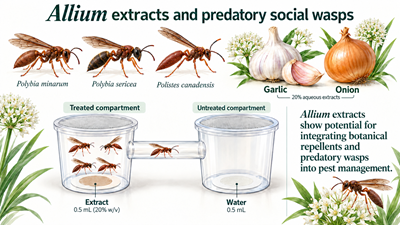
Los repelentes de origen vegetal se consideran cada vez más para el manejo de plagas, pero sus efectos sobre insectos benéficos no objetivo aún no se comprenden suficientemente. Este estudio evaluó las respuestas repelentes y comportamentales de tres especies de avispas sociales depredadoras, Polybia minarum, Polybia sericea y Polistes canadensis, a extractos acuosos al 20 % (p/v) de cebolla (Allium cepa) y ajo (Allium sativum). Las hembras adultas fueron evaluadas en arenas de libre movimiento que contenían compartimentos tratado y no tratado, y la repelencia se cuantificó mediante un índice de evasión. También se registraron respuestas comportamentales cualitativas durante los ensayos. El extracto de cebolla no produjo repelencia significativa en ninguna de las especies. El extracto de ajo indujo repelencia significativa únicamente en P. canadensis. No se registró mortalidad durante los ensayos. La exposición al ajo estuvo asociada con interacciones agonísticas, agitación, aumento del movimiento, aparentes intentos de escape y autoacicalamiento, mientras que la cebolla no causó alteraciones comportamentales evidentes. Estos resultados indican que los extractos acuosos de especies filogenéticamente próximas de Allium pueden producir efectos contrastantes y específicos de cada especie sobre las avispas sociales depredadoras. Por lo tanto, los ensayos comportamentales con organismos no objetivo deberían incluirse en la evaluación de productos de origen vegetal destinados al manejo integrado de plagas, particularmente en sistemas en los que las avispas sociales contribuyen al control biológico.
Descargas
Referencias bibliográficas
Barbosa, B. C., Detoni, M., Maciel, T. T., & Prezoto, F. (2016). Studies of social wasp diversity in Brazil: Over 30 years of research, advancements and priorities. Sociobiology, 63(3), 858-880. https://doi.org/10.13102/sociobiology.v63i3.1031 DOI: https://doi.org/10.13102/sociobiology.v63i3.1031
Brodmann, J., Twele, R., Francke, W., Hölzler, G., Zhang, Q.-H., & Ayasse, M. (2008). Orchids mimic green-leaf volatiles to attract prey-hunting wasps for pollination. Current Biology, 18(10), 740-744. https://doi.org/10.1016/j.cub.2008.04.040 DOI: https://doi.org/10.1016/j.cub.2008.04.040
Casida, J. E., & Durkin, K. A. (2013). Neuroactive insecticides: Targets, selectivity, resistance, and secondary effects. Annual Review of Entomology, 58, 99-117. https://doi.org/10.1146/annurev-ento-120811-153645 DOI: https://doi.org/10.1146/annurev-ento-120811-153645
Clemente, M. A., Lange, D., Del-Claro, K., Prezoto, F., Campos, N. R., & Barbosa, B. C. (2012). Flower-visiting social wasps and plants interaction: Network pattern and environmental complexity. Psyche: A Journal of Entomology, 2012, Article 478431. https://doi.org/10.1155/2012/478431 DOI: https://doi.org/10.1155/2012/478431
Costa, L. M. T., Smagghe, G., Viteri Jumbo, L. O., Santos, G. R., Aguiar, R. W. S., & Oliveira, E. E. (2025). Selective actions of plant-based biorational pesticides: Molecular mechanisms and reduced risks to non-target organisms. Current Opinion in Environmental Science & Health, 44, Article 100601. https://doi.org/10.1016/j.coesh.2025.100601 DOI: https://doi.org/10.1016/j.coesh.2025.100601
Dancewicz, K., & Gabrys, B. (2008). Effect of extracts of garlic (Allium sativum L.), wormwood (Artemisia absinthium L.) and tansy (Tanaceum vulgare L.) on the behaviour of the peach potato aphid Myzus persicae (Sulz.) during the settling on plants. Pestycydy, 3, 93-99.
Dausch, J. G., & Nixon, D. W. (1990). Garlic: A review of its relationship to malignant disease. Preventive Medicine, 19(3), 346-361. https://doi.org/10.1016/0091-7435(90)90034-h DOI: https://doi.org/10.1016/0091-7435(90)90034-H
Desneux, N., Decourtye, A., & Delpuech, J. M. (2007). The sublethal effects of pesticides on beneficial arthropods. Annual Review of Entomology, 52, 81-106. https://doi.org/10.1146/annurev.ento.52.110405.091440 DOI: https://doi.org/10.1146/annurev.ento.52.110405.091440
Elisei, T., Nunes, J. V., Ribeiro Junior, C., Fernandes Junior, A. J., & Prezoto, F. (2010). Uso da vespa social Polistes versicolor no controle de desfolhadores de eucalipto. Pesquisa Agropecuária Brasileira, 45(9), 958-964. https://doi.org/10.1590/S0100-204X2010000900004 DOI: https://doi.org/10.1590/S0100-204X2010000900004
Elisei, T., Ribeiro Junior, C., Fernandes Junior, A. J., Nunes, J. V., Souza, A. R. de, & Prezoto, F. (2012). Management of social wasp colonies in eucalyptus plantations (Hymenoptera: Vespidae). Sociobiology, 59(4), 1167-1174. https://doi.org/10.13102/sociobiology.v59i4.497 DOI: https://doi.org/10.13102/sociobiology.v59i4.497
Falcón-Piñeiro, A., García-López, D., Gil-Martínez, L., Torre, J. M. de la, Carmona-Yañez, M. D., Katalayi-Muleli, A., Guillamón, E., Barrero-Domínguez, B., López-Feria, S., Garrido, D., & Baños, A. (2023). PTS and PTSO, two organosulfur compounds from onion by-products as a novel solution for plant disease and pest management. Chemical and Biological Technologies in Agriculture, 10, Article 76. https://doi.org/10.1186/s40538-023-00452-1 DOI: https://doi.org/10.1186/s40538-023-00452-1
Giunti, G., Benelli, G., Palmeri, V., Laudani, F., Ricupero, M., Ricciardi, R., Maggi, F., Lucchi, A., Guedes, R. N. C., Desneux, N., & Campolo, O. (2022). Non-target effects of essential oil-based biopesticides for crop protection: Impact on natural enemies, pollinators, and soil invertebrates. Biological Control, 176, Article 105071. https://doi.org/10.1016/j.biocontrol.2022.105071 DOI: https://doi.org/10.1016/j.biocontrol.2022.105071
Isman, M. B. (2020). Botanical insecticides in the twenty-first century: Fulfilling their promise? Annual Review of Entomology, 65, 233-249. https://doi.org/10.1146/annurev-ento-011019-025010 DOI: https://doi.org/10.1146/annurev-ento-011019-025010
Jactel, H., Verheggen, F., Thiéry, D., Escobar-Gutiérrez, A. J., Gachet, E., Desneux, N., & Neonicotinoids Working Group. (2019). Alternatives to neonicotinoids. Environment International, 129, 423-429. https://doi.org/10.1016/j.envint.2019.04.045 DOI: https://doi.org/10.1016/j.envint.2019.04.045
Legan, A. W., Jernigan, C. M., Miller, S. E., Fuchs, M. F., & Sheehan, M. J. (2021). Expansion and accelerated evolution of 9-exon odorant receptors in Polistes paper wasps. Molecular Biology and Evolution, 38(9), 3832-3846. https://doi.org/10.1093/molbev/msab023 DOI: https://doi.org/10.1093/molbev/msab023
Lisi, F., Siscaro, G., Biondi, A., Zappalà, L., & Ricupero, M. (2025). Non-target effects of bioinsecticides on natural enemies of arthropod pests. Current Opinion in Environmental Science & Health, 45, Article 100624. https://doi.org/10.1016/j.coesh.2025.100624 DOI: https://doi.org/10.1016/j.coesh.2025.100624
Mobki, M., Safavi, S. A., Safaralizadeh, M. H., & Panahi, O. (2014). Toxicity and repellency of garlic (Allium sativum L.) extract grown in Iran against Tribolium castaneum (Herbst) larvae and adults. Archives of Phytopathology and Plant Protection, 47(1), 59-68. https://doi.org/10.1080/03235408.2013.802896 DOI: https://doi.org/10.1080/03235408.2013.802896
Nchu, F., Eloff, J. N., & Magano, S. R. (2016). Repellent activities of dichloromethane extract of Allium sativum (garlic) (Liliaceae) against Hyalomma rufipes (Acari). Journal of the South African Veterinary Association, 87(1), Article a1356. https://doi.org/10.4102/jsava.v87i1.1356 DOI: https://doi.org/10.4102/jsava.v87i1.1356
Numa Vergel, S. J., Bustos, R. A., Rodríguez, C. D., & Cantor, R. F. (2011). Laboratory and greenhouse evaluation of the entomopathogenic fungi and garlic-pepper extract on the predatory mites, Phytoseiulus persimilis and Neoseiulus californicus and their effect on the spider mite Tetranychus urticae. Biological Control, 57(2), 143-149. https://doi.org/10.1016/j.biocontrol.2011.02.007 DOI: https://doi.org/10.1016/j.biocontrol.2011.02.007
Palermo, D., Giunti, G., Laudani, F., Palmeri, V., & Campolo, O. (2021). Essential oil-based nano-biopesticides: Formulation and bioactivity against the confused flour beetle Tribolium confusum. Sustainability, 13(17), Article 9746. https://doi.org/10.3390/su13179746 DOI: https://doi.org/10.3390/su13179746
Passos, L. C., Ricupero, M., Gugliuzzo, A., Soares, M. A., Desneux, N., Campolo, O., Carvalho, G. A., Biondi, A., & Zappalà, L. (2022). Sublethal effects of plant essential oils toward the zoophytophagous mirid Nesidiocoris tenuis. Journal of Pest Science, 95, 1609-1619. https://doi.org/10.1007/s10340-022-01548-7 DOI: https://doi.org/10.1007/s10340-022-01548-7
Pavela, R., Maggi, F., Campolo, O., Giunti, G., & Spinozzi, E. (2026). Essential oils: Promising active ingredients of botanical insecticides or hidden risks for non-target organisms? Entomologia Generalis, 46(2), 327-329. https://doi.org/10.1127/entomologia/4462 DOI: https://doi.org/10.1127/entomologia/4462
Picanço, M. C., Oliveira, I. R., Rosado, J. F., Silva, F. M., Gontijo, P. C., & Silva, R. S. (2010). Natural biological control of Ascia monuste by the social wasp Polybia ignobilis (Hymenoptera: Vespidae). Sociobiology, 56(1), 67-76.
Prezoto, F., & Machado, V. L. L. (1999a). Ação de Polistes (Aphanilopterus) simillimus Zikán (Hymenoptera: Vespidae) na produtividade de lavoura de milho infestada com Spodoptera frugiperda (Smith) (Lepidoptera: Noctuidae). Revista Brasileira de Zoociências, 1(1), 19-30.
Prezoto, F., & Machado, V. L. L. (1999b). Ação de Polistes (Aphanilopterus) simillimus Zikán (Hymenoptera: Vespidae) no controle de Spodoptera frugiperda (Smith) (Lepidoptera: Noctuidae). Revista Brasileira de Zoologia, 16(3), 841-850. https://doi.org/10.1590/S0101-81751999000300021 DOI: https://doi.org/10.1590/S0101-81751999000300021
Prezoto, F., & Machado, V. L. L. (1999c). Transferência de colônias de vespas (Polistes simillimus Zikán, 1951) (Hymenoptera: Vespidae) para abrigos artificiais e sua manutenção em uma cultura de Zea mays L. Revista Brasileira de Entomologia, 43(3-4), 239-241.
Prezoto, F., Maciel, T. T., Detoni, M., Mayorquin, A. Z., & Barbosa, B. C. (2019). Pest control potential of social wasps in small farms and urban gardens. Insects, 10(7), Article 192. https://doi.org/10.3390/insects10070192 DOI: https://doi.org/10.3390/insects10070192
Ricupero, M., Biondi, A., Cincotta, F., Condurso, C., Palmeri, V., Verzera, A., Zappalà, L., & Campolo, O. (2022). Bioactivity and physico-chemistry of garlic essential oil nanoemulsion in tomato. Entomologia Generalis, 42(6), 921-930. https://doi.org/10.1127/entomologia/2022/1553 DOI: https://doi.org/10.1127/entomologia/2022/1553
Santos, G. M. M., Bichara-Filho, C. C., Resende, J. J., Cruz, J. D., & Marques, O. M. (2007). Flower-visiting social wasps (Hymenoptera: Vespidae) from a Brazilian cerrado ecosystem. Neotropical Entomology, 36(6), 834-838. https://doi.org/10.1590/S1519-566X2007000600007 DOI: https://doi.org/10.1590/S1519-566X2007000200002
Schmack, J. M., & Egerer, M. (2023). Floral richness and seasonality influences bee and non-bee flower interactions in urban community gardens. Urban Ecosystems, 26, 1099-1112. https://doi.org/10.1007/s11252-023-01353-9 DOI: https://doi.org/10.1007/s11252-023-01353-9
Schneider, E. (1986). A cura e a saúde pelos alimentos. Casa Publicadora Brasileira.
Silva, A. C. B., & Pelli, A. (2021). Avaliação da repelência de Allium sativum L. (alho) visando o controle de Nauphoeta cinerea (Olivier, 1789). Acta Ambiental Catarinense, 19, 1-7. https://doi.org/10.24021/raac.v19i1.6225 DOI: https://doi.org/10.24021/raac.v19i1.6225
Soares, A. P., Zocolo, G. J., & Bueno, A. F. (2026). The overlooked impact of botanical pesticides on non-target organisms. Plants, 15(6), Article 917. https://doi.org/10.3390/plants15060917 DOI: https://doi.org/10.3390/plants15060917
Southon, R. J., Fernandes, O. A., Nascimento, F. S., & Sumner, S. (2019). Social wasps are effective biocontrol agents of key lepidopteran crop pests. Proceedings of the Royal Society B, 286(1914), Article 20191676. https://doi.org/10.1098/rspb.2019.1676 DOI: https://doi.org/10.1098/rspb.2019.1676
Souto, A. L., Sylvestre, M., Tölke, E. D., Tavares, J. F., Barbosa-Filho, J. M., & Cebrián-Torrejón, G. (2021). Plant-derived pesticides as an alternative to pest management and sustainable agricultural production: Prospects, applications and challenges. Molecules, 26(16), Article 4835. https://doi.org/10.3390/molecules26164835 DOI: https://doi.org/10.3390/molecules26164835
Souza, A. R. de, Baptista, C. F., Teixeira, G. V. M., & Lima, M. A. P. (2021). Artificial environments for studying eusocial wasps. In F. Prezoto, F. S. Nascimento, B. C. Barbosa, & A. Somavilla (Eds.), Neotropical social wasps (pp. 449-465). Springer. https://doi.org/10.1007/978-3-030-53510-0_23 DOI: https://doi.org/10.1007/978-3-030-53510-0_23
Souza, A. R. de, Diniz, R., Santos, S. A. dos, Lima, L. D., Santos, E. F., Polo, J. L. L., Nascimento, F. S. do, & Lima, M. A. P. (2026). Imidacloprid ingestion alters the behavior of the natural enemy Mischocyttarus cassununga (Hymenoptera: Vespidae). Environmental Toxicology and Chemistry, 45(3), 710-718. https://doi.org/10.1093/etojnl/vgaf300 DOI: https://doi.org/10.1093/etojnl/vgaf300
Tavares, W. R., Barreto, M. C., & Seca, A. M. (2021). Aqueous and ethanolic plant extracts as bio-insecticides: Establishing a bridge between raw scientific data and practical reality. Plants, 10(5), Article 920. https://doi.org/10.3390/plants10050920 DOI: https://doi.org/10.3390/plants10050920
Teixeira, G. V. M., Souza, A. R. de, Barbosa, W. F., Bernardes, R. C., & Lima, M. A. P. (2022). Chronic exposure to a common biopesticide is detrimental to individuals and colonies of the paper wasp Polistes versicolor. Science of The Total Environment, 810, Article 152108. https://doi.org/10.1016/j.scitotenv.2021.152108 DOI: https://doi.org/10.1016/j.scitotenv.2021.152108
van Zweden, J. S., & d’Ettorre, P. (2010). Nestmate recognition in social insects and the role of hydrocarbons. In G. J. Blomquist & A. G. Bagnères (Eds.), Insect hydrocarbons: Biology, biochemistry, and chemical ecology (pp. 222-243). Cambridge University Press. DOI: https://doi.org/10.1017/CBO9780511711909.012
Xavier, V. M., Picanço, M. C., Chediak, M., Santana Júnior, P. A., Ramos, R. S., & Martins, J. C. (2015). Acute toxicity and sublethal effects of botanical insecticides to honey bees. Journal of Insect Science, 15(1), Article 137. https://doi.org/10.1093/jisesa/iev110 DOI: https://doi.org/10.1093/jisesa/iev110
Descargas
Publicado
Cómo citar
Número
Sección
Licencia
Derechos de autor 2026 Agrociencia Uruguay

Esta obra está bajo una licencia internacional Creative Commons Atribución 4.0.
| Estadísticas de artículo | |
|---|---|
| Vistas de resúmenes | 183 |
| Vistas de PDF | 71 |
| Descargas de PDF | 71 |
| Vistas de HTML | 0 |
| Otras vistas | 0 |


















