Temperamento de vacas Holando de origen neozelandés y norteamericano mantenidas en dos estrategias alimentarias diferentes
DOI:
https://doi.org/10.31285/AGRO.29.1467Palabras clave:
biotipo, bovino, leche, personalidadResumen
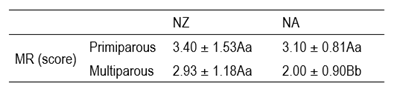
La genética es un factor que influye en el temperamento animal. El objetivo de este trabajo fue comparar la respuesta a tres pruebas de temperamento de vacas Holando neozelandesas (NZ) y norteamericanas (NA) bajo dos estrategias de alimentación. Ciento veinte vacas de la Unidad Experimental del Instituto Nacional de Investigación Agropecuaria (INIA, Uruguay) fueron agrupadas en una combinación de dos orígenes genéticos: NZ o NA, con dos estrategias de alimentación: Máximo pasto o Pasto fijo. La reactividad al ordeñe (RO), la velocidad de fuga y la distancia de fuga (DF) fueron evaluadas en dos períodos (107,5 ± 30,3 y 173,8 ± 32,1 días en leche), y el promedio de esas dos mediciones por animal fue utilizado en modelos lineales generales con la genética (NZ vs NA), la paridad (primíparas vs multíparas), la estrategia de alimentación (Máximo pasto vs. Pasto fijo) y sus interacciones como efectos fijos. Hubo una interacción entre origen genético y paridad para la RO. Las diferencias entre vacas NZ y NA fueron solo observadas en multíparas, presentando mayores valores las vacas NZ (2,93 ± 1,18) que las NA (2,00 ± 0,90) (P=0.0004). Las vacas NZ presentaron mayor DF (4,2 ± 1,3 m) que vacas NA (3,7 ± 1,1 m) (P=0,03). La estrategia de alimentación no afectó la respuesta a ninguna prueba. En conclusión, el origen genético de vacas lecheras Holstein influenció la reactividad a las pruebas de temperamento RO y DF. Las vacas NZ fueron más reactivas al humano y al ordeñe que las vacas NA, pero las diferencias en RO fueron solo observadas en vacas multíparas.
Descargas
Referencias bibliográficas
Antanaitis R, Juozaitienė V, Jonike V, Čukauskas V, Urbšienė D, Urbšys A, Baumgartner W, Paulauskas A. Relationship between temperament and stage of lactation, productivity and milk composition of dairy cows. Animals (Basel). 2021;11(7):1840. Doi: 10.3390/ani11071840. DOI: https://doi.org/10.3390/ani11071840
Battini M, Andreoli E, Barbieri S, Mattiello S. Long-term stability of avoidance distance tests for on-farm assessment of dairy cow relationship to humans in alpine traditional husbandry systems. Appl Anim Behav Sci. 2011;135:267-70. Doi: 10.1016/j.applanim.2011.10.013. DOI: https://doi.org/10.1016/j.applanim.2011.10.013
Berry DP, Harris BL, Winkelman AM, Montgomerie W. Phenotypic associations between traits other than production and longevity in New Zealand dairy cattle. J Dairy Sci. 2005;88(8):2962-74. Doi: 10.3168/jds.S0022-0302(05)72976-3. DOI: https://doi.org/10.3168/jds.S0022-0302(05)72976-3
Breuer K, Hemsworth PH, Barnett JL, Matthews LR, Coleman GJ. Behavioural response to humans and the productivity of commercial dairy cows. Appl Anim Behav Sci. 2000;66(4):273-88. Doi: 10.1016/s0168-1591(99)00097-0. DOI: https://doi.org/10.1016/S0168-1591(99)00097-0
Cerqueira JOL, Araújo JPP, Blanco-Penedo I, Cantalapiedra J, Sørensen JT, Niza-Ribeiro JJR. Relationship between stepping and kicking behavior and milking management in dairy cattle herds. J Vet Behav. 2017;19:72-7. Doi: 10.1016/j.jveb.2017.02.002. DOI: https://doi.org/10.1016/j.jveb.2017.02.002
Chan FY. Genome wide association studies for temperament in New Zealand dairy cattle [master’s thesis]. Palmerston North (NZ): Massey University; 2012. 93p.
Chen Q, Zhang F, Qu K, Hanif Q, Shen J, Jia P, Ning Q, Zhan J, Zhang J, Chen N, Chen H, Huang B, Lei C. Genome-wide association study identifies genomic loci associated with flight reaction in cattle. J Anim Breed Genet. 2020;137(5):477-85. Doi: 10.1111/jbg.12461. DOI: https://doi.org/10.1111/jbg.12461
Crossley RE, Bokkers EAM, Browne N, Sugrue K, Kennedy E, de Boer IJM, Conneely M. Assessing dairy cow welfare during the grazing and housing periods on spring-calving, pasture-based dairy farms. J Anim Sci. 2021;99(5):skab093. Doi: 10.1093/jas/skab093. DOI: https://doi.org/10.1093/jas/skab093
Fordyce G, Goddard ME, Seifert GW. The measurement of temperament in cattle and the effect of experience and genotype. Proc Aust Soc Anim Prod. 1982;14:329-32.
Friedrich J, Brand B, Schwerin M. Genetics of cattle temperament and its impact on livestock production and breeding: a review. Arch Anim Breed. 2015;58:13-21. Doi: 10.5194/aab-58-13-2015. DOI: https://doi.org/10.5194/aab-58-13-2015
Gibbons JM, Lawrence AB, Haskell MJ. Consistency of flight speed and response to restraint in a crush in dairy cattle. Appl Anim Behav Sci. 2011;131:15-20. Doi: 10.1016/j.applanim.2011.01.009. DOI: https://doi.org/10.1016/j.applanim.2011.01.009
Harris BL, Kolver ES. Review of Holsteinization on intensive pastoral dairy farming in New Zealand. J Dairy Sci. 2001;84 Suppl.:E56-E61. Doi: 10.3168/jds.S0022-0302(01)70197-X. DOI: https://doi.org/10.3168/jds.S0022-0302(01)70197-X
Haskell MJ, Simm G, Turner SP. Genetic selection for temperament traits in dairy and beef cattle. Front Genet. 2014;5:368. Doi: 10.3389/fgene.2014.00368. DOI: https://doi.org/10.3389/fgene.2014.00368
Hedlund L, Løvlie H. Personality and production: nervous cows produce less milk. J Dairy Sci. 2015;98(9):5819-28. Doi: 10.3168/jds.2014-8667. DOI: https://doi.org/10.3168/jds.2014-8667
Hemsworth PH. Human-animal interactions in livestock production. Appl Anim Behav Sci. 2003;81:185-98. Doi: 10.1016/s0168-1591(02)00280-0. DOI: https://doi.org/10.1016/S0168-1591(02)00280-0
INALE. Encuesta Lechera 2019: resultados preliminares [Internet]. Montevideo: INALE; 2019 [cited 2025 Feb 27]. Available from: https://www.inale.org/estadisticas/encuesta-lechera-2019-resultados-preliminares/
Jago J, Kerrisk K. Training methods for introducing cows to a pasture-based automatic milking system. Appl Anim Behav Sci. 2011;131:79-85. Doi: 10.1016/j.applanim.2011.02.002. DOI: https://doi.org/10.1016/j.applanim.2011.02.002
Koolhaas JM, de Boer SF, Coppens CM, Buwalda B. Neuroendocrinology of coping styles: towards understanding the biology of individual variation. Front Neuroendocrinol. 2010;31(3):307-21. Doi: 10.1016/j.yfrne.2010.04.001. DOI: https://doi.org/10.1016/j.yfrne.2010.04.001
Lawstuen DA, Hansen LB, Steuernagel GR, Johnson LP. Management traits scored linearly by dairy producers. J Dairy Sci. 1988;71:788-99. Doi: 10.3168/jds.S0022-0302(88)79619-8. DOI: https://doi.org/10.3168/jds.S0022-0302(88)79619-8
Marçal-Pedroza MG, Campos MM, Sacramento JP, Pereira LGR, Machado FS, Tomich TR, Paranhos da Costa MJR, Sant'Anna AC. Are dairy cows with a more reactive temperament less efficient in energetic metabolism and do they produce more enteric methane? Animal. 2021;15(6):100224. Doi: 10.1016/j.animal.2021.100224. DOI: https://doi.org/10.1016/j.animal.2021.100224
Marçal-Pedroza MG, Canozzi MEA, Campos MM, Sant'Anna AC. Effects of dairy cow temperament on milk yield: a systematic review and meta-analysis. J Anim Sci. 2023;101:skad099. Doi: 10.1093/jas/skad099. DOI: https://doi.org/10.1093/jas/skad099
Mendoza A, Fernandez G, Fariña S, Capelesso A, Cajarville C, Ungerfeld R. Holstein genetic strains and feeding system affects feeding behaviour strategy of dairy cows during late lactation [Internet]. 2018 [cited 2025 Feb 27]. Available from: https://www.researchgate.net/publication/333811810_Holstein_genetic_strains_and_feeding_system_affects_feeding_behaviour_strategy_of_dairy_cows_during_late_lactation.
Miglior F, Muir BL, Van Doormaal BJ. Selection indices in Holstein cattle of various countries. J Dairy Sci. 2005;88(3):1255-63. Doi: 10.3168/jds.S0022-0302(05)72792-2. DOI: https://doi.org/10.3168/jds.S0022-0302(05)72792-2
Morales-Piñeyrúa JT, Damián JP, Banchero G, Blache D, Sant'Anna AC. Metabolic profile and productivity of dairy Holstein cows milked by a pasture-based automatic milking system during early lactation: effects of cow temperament and parity. Res Vet Sci. 2022;147:50-9. Doi: 10.1016/j.rvsc.2022.04.001. DOI: https://doi.org/10.1016/j.rvsc.2022.04.001
Morales-Piñeyrúa JT, Sant'Anna AC, Banchero G, Damián JP. Dairy cows' temperament and milking performance during the adaptation to an automatic milking system. Animals (Basel). 2023;13(4):562. Doi: 10.3390/ani13040562. DOI: https://doi.org/10.3390/ani13040562
Mpisana Z, Jaja IF, Oguttu J, Muchenje V. Avoidance behaviour of first lactating cows in a pasture-based dairy system in South Africa. J Anim Health Prod. 2021;9(3):277-84. Doi: 10.17852/journal.jahp/2021/9.3.277.284.
Norris D, Ngambi JW, Mabelebele M, Alabi OJ, Benyi K. Genetic selection for docility: a review. J Anim Plant Sci. 2014;24(1):13-8.
Orbán M, Gaál KK, Pajor F, Szentléleki A, Póti P, Tőzsér J, Gulyás L. Effect of temperament of Jersey and Holstein Friesian cows on milk production traits and somatic cell count. Arch Anim Breed. 2011;54(6):594-9. Doi: 10.5194/aab-54-594-2011. DOI: https://doi.org/10.5194/aab-54-594-2011
Réale D, Reader SM, Sol D, McDougall PT, Dingemanse NJ. Integrating animal temperament within ecology and evolution. Biol Rev Camb Philos Soc. 2007;82(2):291-318. Doi: 10.1111/j.1469-185X.2007.00010.x. DOI: https://doi.org/10.1111/j.1469-185X.2007.00010.x
Sewalem A, Miglior F, Kistemaker GJ. Analysis of the relationship between workability traits and functional longevity in Canadian dairy breeds. J Dairy Sci. 2010;93(9):4359-65. Doi: 10.3168/jds.2009-2969. DOI: https://doi.org/10.3168/jds.2009-2969
Sewalem A, Miglior F, Kistemaker GJ. Genetic parameters of milking temperament and milking speed in Canadian Holsteins. J Dairy Sci. 2011;94(1):512-6. Doi: 10.3168/jds.2010-3479. DOI: https://doi.org/10.3168/jds.2010-3479
Stirling S, Delaby L, Mendoza A, Fariña S. Intensification strategies for temperate hot-summer grazing dairy systems in South America: effects of feeding strategy and cow genotype. J Dairy Sci. 2021;104(12):12647-63. Doi: 10.3168/jds.2021-20507. DOI: https://doi.org/10.3168/jds.2021-20507
Sutherland MA, Dowling SK. The relationship between responsiveness of first-lactation heifers to humans and the behavioral response to milking and milk production measures. J Vet Behav. 2014;9:30-3. Doi: 10.1016/j.jveb.2013.09.001. DOI: https://doi.org/10.1016/j.jveb.2013.09.001
Sutherland MA, Huddart FJ. The effect of training first-lactation heifers to the milking parlor on the behavioral reactivity to humans and the physiological and behavioral responses to milking and productivity. J Dairy Sci. 2012;95(12):6983-93. Doi: 10.3168/jds.2011-5211. DOI: https://doi.org/10.3168/jds.2011-5211
Sutherland MA, Rogers AR, Verkerk GA. The effect of temperament and responsiveness towards humans on the behavior, physiology and milk production of multi-parous dairy cows in a familiar and novel milking environment. Physiol Behav. 2012;107(3):329-37. Doi: 10.1016/j.physbeh.2012.07.013. DOI: https://doi.org/10.1016/j.physbeh.2012.07.013
Talmón D, Mendoza A, Carriquiry M. Holstein strains affects energy and feed efficiency in a grazing dairy system. Anim Prod Sci. 2022;62:765-73. Doi: 10.1071/AN20587. DOI: https://doi.org/10.1071/AN20587
Waiblinger S, Boivin X, Pedersen V, Tosi MV, Janczak AM, Visser EK, Jones RB. Assessing the human–animal relationship in farmed species: a critical review. Appl Anim Behav Sci. 2006;101:185-242. Doi: 10.1016/j.applanim.2006.02.001. DOI: https://doi.org/10.1016/j.applanim.2006.02.001
Descargas
Publicado
Cómo citar
Número
Sección
Licencia
Derechos de autor 2025 Agrociencia Uruguay

Esta obra está bajo una licencia internacional Creative Commons Atribución 4.0.

| Estadísticas de artículo | |
|---|---|
| Vistas de resúmenes | |
| Vistas de PDF | |
| Descargas de PDF | |
| Vistas de HTML | |
| Otras vistas | |